
Panama, Safe Land: Why the Canal Was Built Here
 written by one who's been there
The day I understood why they dug that hole
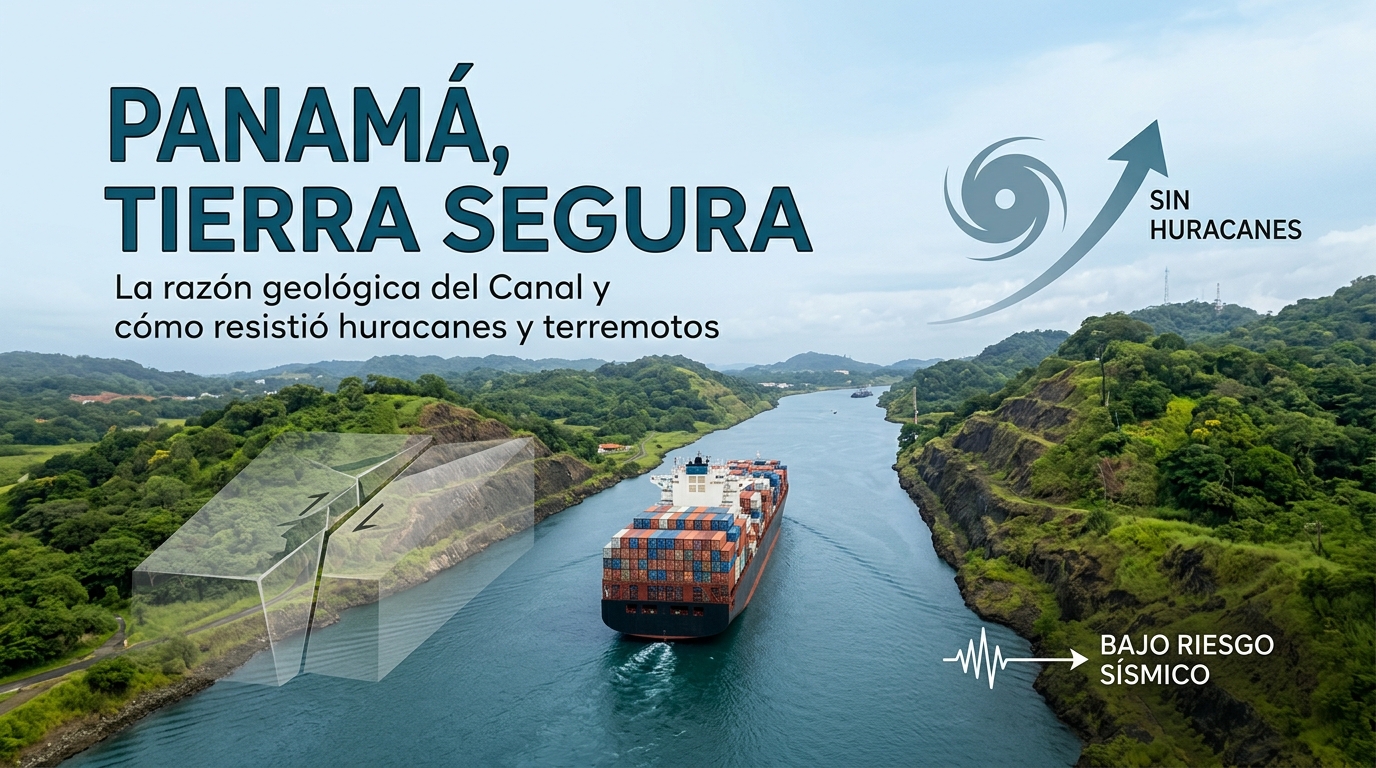
I fly low, almost brushing the canopy of Darién. From above, Panama looks like a clenched fist between two oceans. But it wasn't always like that. Millions of years ago, a sea strait ran through here. Then the land emerged, and the two seas separated. That changed the planet's climate. And centuries later, humans decided to reconnect them. With pick and shovel. Well, pick, shovel, and dynamite. The main reason: Panama was a safe land. Not in the sense of pothole-free streets or cops on every corner. Safe because there are no hurricanes like in the northern Caribbean, no earthquakes like in Nicaragua, no active volcanoes. The isthmus is a narrow corridor, but stable. The French engineers first, and the Americans later, were looking for a place where the weather wouldn't blow up their works every season. And Panama gave them that: firm ground, predictable rains, and a geography that already had a river ready to be tamed.
I saw it firsthand. A few years ago, I climbed Cerro Ancón with a guide named Ñato. A guy in his sixties, leathery skin, who's seen generations of tourists pass through. He told me: "Arpy, it doesn't shake here. What we have is water." And it's true. In Panama, the enemy isn't the ground, it's the sky. The rain soaks you in five minutes. But the mountains don't fall. That, for a canal, is worth gold.
The route nobody marked on 19th-century maps
Before the Canal, the route was overland. The Camino de Cruces, a trail of mud and stone that linked Old Panama to Nombre de Dios, and later Portobelo. That's where Inca gold moved toward Spain. The mule drivers, with loaded beasts, sank up to their knees in mud. It smelled of sweat, wet animal, tobacco. And fear. Because pirates lurked. Henry Morgan, Francis Drake, all wanted their cut. Panama was the narrowest point, but also the most coveted. And even so, the land held. The sea didn't swallow it. That was well understood by those who dreamed of a canal.
I walked a stretch of that road with Doña Marta, a lady who sells patacones in the Portobelo market. She told me: "Boy, the land here is hard. That's why the Spanish stayed." Hard and safe. Not like other routes in Central America, where landslides wipe out entire towns every winter. Panama has its downpours, but the terrain is compact. And that, for an 80-kilometer project that had to cross mountains and rivers, was the difference between success and failure.
The French failed, but not because of the land
Ferdinand de Lesseps, the same man who built the Suez Canal, arrived in Panama in 1881 with a dream. He was going to dig a sea-level canal. No locks. Just dirt and water. But he ran into the Chagres. A river that swells like crazy in winter. And yellow fever. And malaria. The French died by the thousands. Not because the ground shook, but because mosquitoes bit them. The land was safe, but the environment wasn't. Still, Lesseps insisted. He lost. He went broke. And he left a bunch of rusty machinery that you can see in museums today. I saw a French dredge at the Canal Museum in Casco Antiguo. It's all rusted. It's eerie. But also funny: the guy wanted to move the sea without locks, and the Chagres laughed in his face.
The Americans learned the lesson
When the United States took over in 1904, the first thing they did was fumigate. Literally. William Gorgas, a military doctor, ordered brush burned, puddles drained, wire screens on windows. Yellow fever was controlled. And then, yes, they started digging. But not at sea level. With locks. And they chose Panama for several reasons: the land was stable, the isthmus was short, and there was already a railroad that could move material. Also, Panama had no active volcanoes or major geological faults. In other countries in the region, like Nicaragua, there were volcanoes that could ruin everything. In fact, the Americans almost built the canal in Nicaragua. But an engineer named Philippe Bunau-Varilla sent them a Nicaraguan stamp with a smoking volcano. And told them: "Do you want this?" No. They preferred Panama. Safe land. No volcanoes. No hurricanes. Just rain and jungle.
What I learned on the Chagres trail
A few months ago, I hiked the trail that goes up to Gatun Lake. It's not on Maps. You go through a path behind the dam, past a rusty gate. You have to ask permission at the ACP office, but if you go with a local guide, they let you in. I walked for two hours. The heat hits you like a wet blanket. The chitres eat you alive. But you reach a viewpoint and see the lake. Immense. Green. With islands that used to be hills. That's where I understood everything. The Chagres, once a wild river, is now a controlled lake. Safe land became safe water. And the canal works because Panama doesn't move. No earthquakes to break the locks. No hurricanes to block the passage. Just rain. And rain is managed with gates.
Why Panama is still safe land for investment
Today, the Canal is the golden goose. But not just because of the canal. Panama has a dollarized economy, with no central bank printing money like crazy. That attracts investors. And geography helps: no high seismic risk, no hurricane season like in the northern Caribbean. Sure, there are floods in the rainy season. And landslides on some roads. But nothing compared to other countries. I've traveled through Central America. In Guatemala, volcanoes loom. In Honduras, hurricanes wipe out towns. In Costa Rica, there are active faults. Panama is a haven. A narrow but firm isthmus. And that, even if it sounds boring, is what allowed the canal to be built. And what allows you today to cross from one ocean to another on a ship while sipping coffee on deck.
What I'd bring if you explore the canal route
If you want to see up close why Panama is safe land, don't stay at the Miraflores Locks. Go further. Here's what I bring:
- Rubber boots: the Chagres mud doesn't forgive. Sneakers get left behind.
- DEET repellent: mosquitoes don't know history, but they know fresh blood.
- Rain poncho: not an umbrella. The wind flips it in two seconds.
- Water, lots of water: the heat dehydrates you without you noticing.
- A local guide: not mandatory, but it saves you from getting lost on trails not on Maps.
- Cash: at the patacones and cold coconut stands, there's no card reader.
A closing without a conclusion
Next time someone tells you Panama is just a canal, tell them this: the canal was built here because the land doesn't shake, doesn't sink, doesn't explode. It's a stable piece of the world in a restless region. And if you want to check it, grab a bus to Gamboa, walk to the river, and get in the water. The Chagres will welcome you with its gentle current. There, floating, you'll understand why the engineers chose this corner. Not because it was pretty. Because it was safe. See you on the next bend of the river.
