
The Best Coffee in the World Is in Panama
 written by one who's been there
The Best Coffee in the World Is in Panama (And It's Not What You Think)
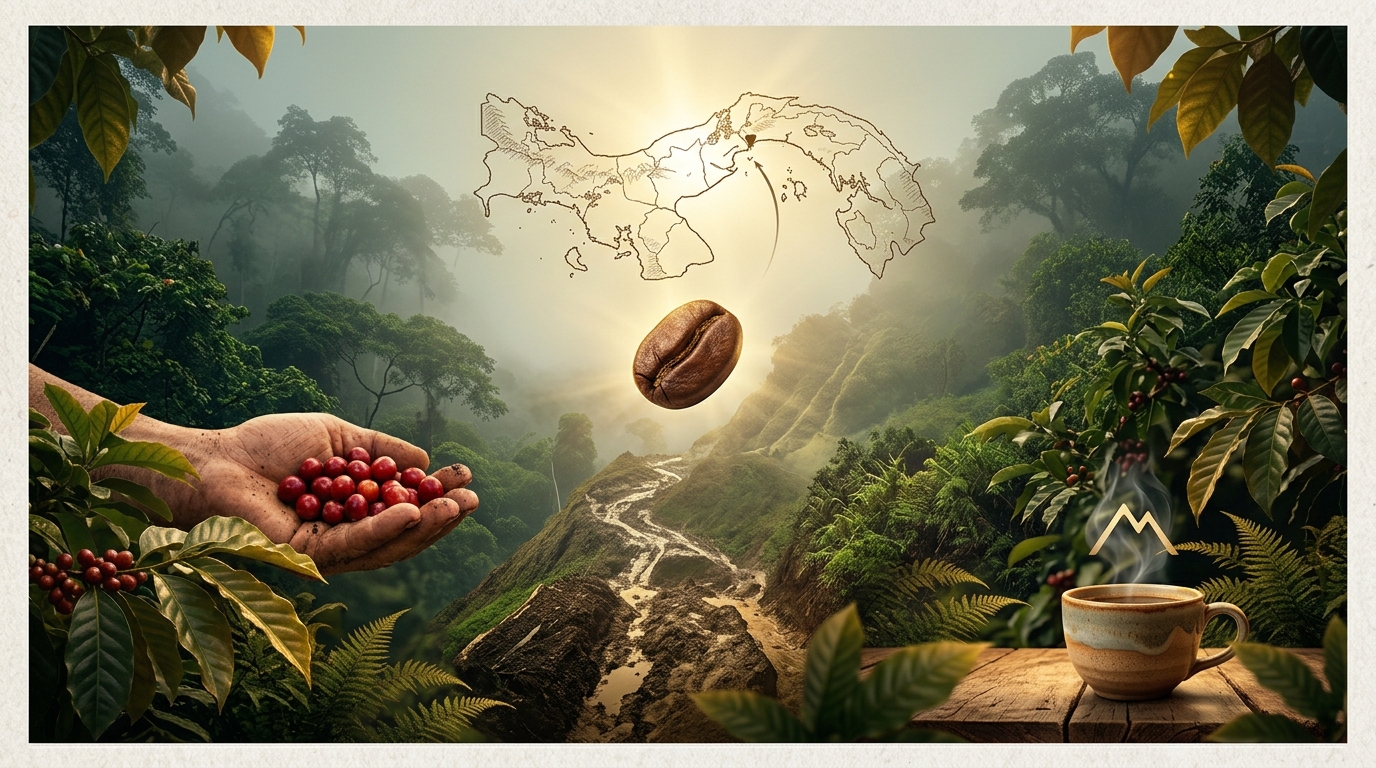
I'm standing on the farm. It's just past six in the morning. The hill still has fog clinging to it like someone threw a duvet over the coffee trees. It smells like wet earth, fermenting pulp, firewood. A few yards down, Don Eloy picks cherries with calloused hands. No gloves. "That's how you feel the exact point," he tells me. I, who come from flying over mountains and seeing rivers like scars from above, down here can only manage not to slip in the mud. The best coffee in the world is in Panama, and I'm not the one saying it: the auctions say it, the judges say it, the Japanese who pay figures I won't repeat because even I don't believe them. But that's not what I came to tell you. I came to tell you how to get there, what it feels like, and why you should come even if you can't tell a geisha from a catuai.
The trail nobody marks on Maps
I left Boquete around 5:30. The truck —a 4x4 that already had a windshield starred from so many rocks— went up a road that on Google Maps appears as a gray line that fades out. Nothing. No signal here. The driver, a guy named Méndez who smokes while driving, told me: "Hold on, this gets ugly." And it got ugly. Rocks, potholes, a river we crossed with water almost coming in through the doors. Forty minutes of shaking. We reached a farm with no sign. Just a green gate and a skinny dog wagging its tail. That's where the trail starts. No map. No app. There's mud, there's slope, there's a silence broken only by birds and wind through the coffee trees. I walked for an hour and didn't cross paths with anyone. That, for someone who flies over an entire country, is strange. And it's good.
How much it really costs to get a real cup of coffee
I'm not going to sell you the idea that it's cheap. It's not. But it's not a millionaire's trip either. Let's break it down:
- Transport: from Panama City to David, a round-trip flight can cost between $150 and $250. By bus, about $30-$40, but it's like 7 hours. From David to Boquete, a taxi or Uber charges $15-$20. If you go to more remote farms, you need a 4x4. Renting one per day: $60-$90.
- Lodging: in Boquete there are hostels from $15 a night. A nice little hotel, $60-$80. On some farms, you can stay in rustic cabins for $40-$50, breakfast included. Note: not all have hot water.
- Coffee tours: a guided visit with tasting costs between $30 and $60. There are two-hour ones and full-day ones. The one I did with Don Eloy was almost five hours and cost me $45. It included picking cherries, seeing the processing, roasting, and tasting. And a fonda lunch that was worth every penny.
- Coffee to go: a pound of geisha can cost from $50 to $300. A pound of regular specialty coffee, $15-$25. Don't buy the one they sell at the airport. It's not the same.
What nobody tells you about the process (and why it matters)
Coffee doesn't grow in a cup. Sounds obvious, but people forget. Watching Don Eloy pick cherry by cherry changes your mind. Only ripe ones are picked. Green ones are left. That's called "selective picking" and it's one of the reasons Panamanian coffee wins awards. Then comes processing: depulping, fermenting, washing, drying. Each step has its science. Don Eloy doesn't use a refractometer or brix meter. He uses his finger, his eye, his nose. "Coffee talks to you," he says. And I, who come from seeing the world from above, down here can only nod. Fermentation is the soul of flavor. If you go over hours, it turns sour. If you cut it short, it tastes like grass. You don't learn that in a two-hour course. You learn it with years of hands in the pulp.
Roasting: where everything is decided
After drying, the bean goes to the roaster. That's where coffee can be ruined or turned to gold. A very dark roast kills the floral notes of geisha. A very light one leaves a raw peanut taste. Don Eloy roasts in an old drum machine that he repairs himself with wire. No computer. There's hearing, smell, and a kitchen timer. The first crack —that sound like popcorn— is the key moment. That's where it's decided if the coffee will be good or just acceptable. I heard it and got goosebumps. I'm not exaggerating.
The tasting: when coffee tastes like fruit, flowers, honey
I had never tasted coffee like that. They gave me five cups. Each from a different lot. The first: jasmine, peach, something citrus. The second: chocolate, caramel, walnut. The third: strawberry, honey, a long finish that wouldn't leave. The fourth: floral, black tea, bergamot. The fifth: I don't remember, because I was already shaking from caffeine. The thing is, specialty coffee doesn't taste like coffee. It tastes like what the bean absorbed from the earth, the climate, the hands that touched it. Don Eloy told me: "Try this and tell me if it's not the best coffee in the world." I didn't tell him, but I thought it. And I still think it.
What I'd do differently the second time
- Bring real boots. Not sneakers. Mud sticks like gum and makes you slip on every curve.
- Book ahead. Good farms fill up. I got lucky because it was low season, but during harvest (December to March) it's chaos.
- Don't rush. Coffee doesn't hurry. If you're doing a two-hour tour, better stay in the city. This takes time, silence, and willingness to get dirty.
- Ask for the producer's name. Don't buy coffee from a generic brand. Ask who grew it, who processed it, who roasted it. If they can't answer, bad sign.
- Bring cash. Many farms don't take cards. And the nearest ATM is 30 minutes away by car.
The best coffee in the world is in Panama, but not in a display case
It's not in a mall in the capital. It's not in one of those cafés that charge $12 for a latte with art. It's in a clay cup, on a wooden table, in a kitchen that smells like firewood and bread. It's in the hands of Doña Marta, who serves coffee with a smile and tells you: "Drink it slowly, this isn't water." It's in Don Eloy's sweat, in the mud of the trail, in the fog that lifts at nine. The best coffee in the world is in Panama, yes. But you won't find it in a bag with a bow. You'll find it if you dare to go up, to ask, to sit in a hammock and wait. I already have my pound saved. Next time I'll bring two. And motion sickness pills, because the road isn't getting fixed. See you at the next cup.
