7.7 Earthquake in Tonosí: What I Lived
 written by one who's been there
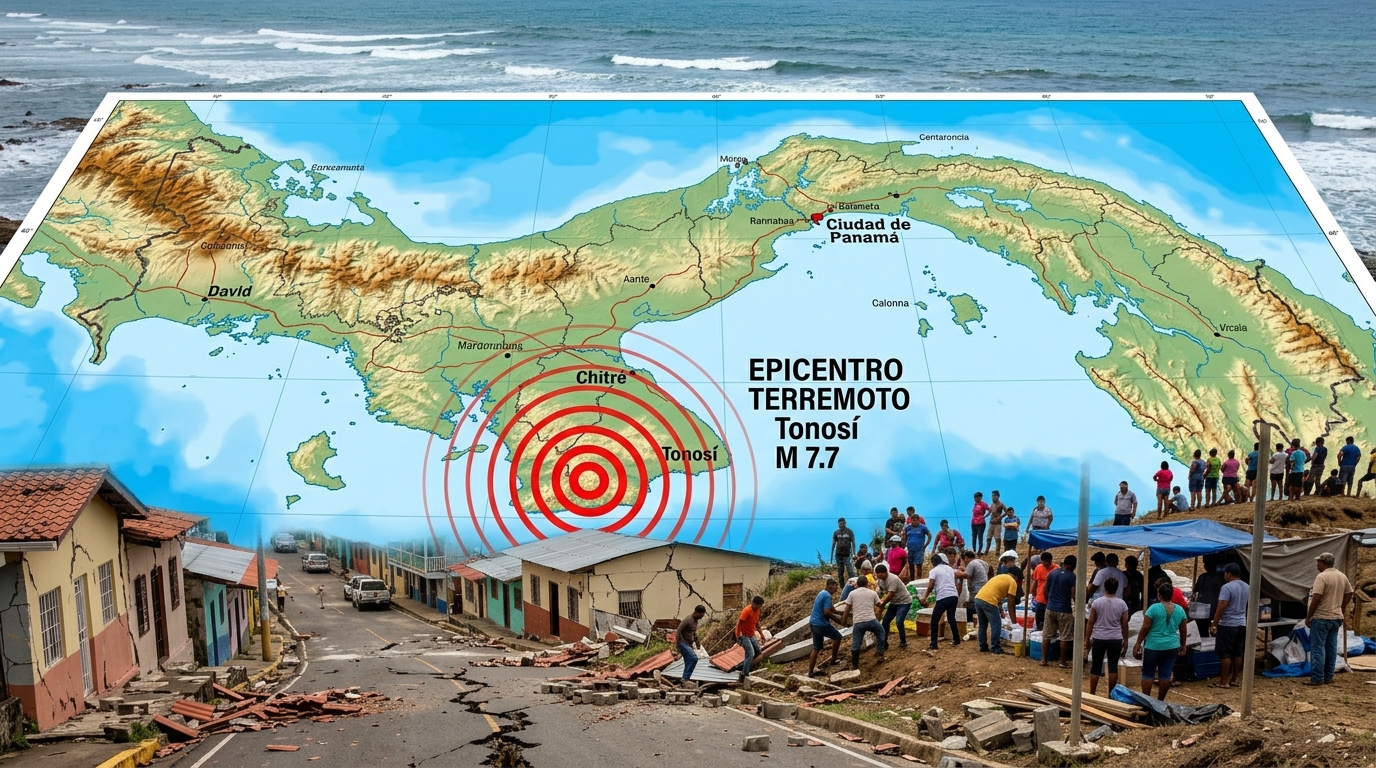
The ground moved. Hard. I was at Doña Chila's food stand in Tonosí, biting into a patacón with cheese. The plate jumped. The glass of orange juice tipped over. People started screaming. This wasn't just any tremor. It was a magnitude 7.7 earthquake, with the epicenter just 12 kilometers from where I was. I looked at my watch: 12:56 PM, October 9, 2026. The harpy eagle inside me wanted to fly, but wings are useless when the earth cracks open.
The roar that came from below
I had never felt anything like it. And I've flown over volcanoes, seen landslides, felt the sea's punch in Coiba. But this was different. The earth didn't tremble: it rumbled like a broken engine. The walls of the food stand creaked. The cans of tuna fell. Doña Chila crossed herself and ran out with her apron. I followed her. In the street, people looked at the sky, as if the danger came from above. No. It came from below, from the fault that no one mentions over dinner.
The epicenter was in Tonosí, in southwestern Panama. Here life is cattle, corn, fishing. And now, a reminder that we're sitting on plates that hate each other. The USGS confirmed it minutes later: 7.7, shallow, near the coast. The tsunami alert didn't wait. It sounded on cell phones. It sounded on the radio. It sounded on the church loudspeaker. "Evacuate coastal areas," they said. And people grabbed what they could: children, documents, chickens. I grabbed my backpack, my field notebook, and a bottle of water.
The tsunami alert that paralyzed four countries
Not just Panama. The tsunami alert extended to Costa Rica, Nicaragua, Honduras, and El Salvador. Four neighboring countries that looked at the Pacific with a tight stomach. In Tonosí, people ran to the hills. Fishermen pulled their boats out of the water. Tourists in Playa Venao, about 40 minutes away, climbed to the viewpoints. I stayed in town, because I wanted to see. Not out of morbid curiosity, but because my job is to tell what happens when the earth shakes.
The alert lasted about two hours. Then it was suspended. The sea didn't come out. There was no giant wave. But the scare was already in our bones. The tsunami alert was canceled, but the fear stayed. In the square, a man in a hat said: "Better safe. I saw the sea in '94, and I don't want to repeat it." Children cried. Women prayed. Men checked the houses. I wrote in my notebook, hand trembling a little.
What I saw from the hill
While the alert was still active, I climbed the highest hill I could find. From above, Tonosí looked tiny. The zinc houses, the river, the road. And beyond, the Pacific, that blue monster that sometimes behaves and sometimes doesn't. From the air you can see the river's scar, but from the hill you see the scar of fear. People huddled, cars badly parked, chickens loose. A dog barked nonstop. As if it knew something we didn't.
I sat on a rock. I thought about my family, my friends, the people who live on the coast. If the tsunami had come, what would have happened? I don't want to imagine it. But Panamanians are like this: we get scared, we pray, and soon we're eating rice with chicken. Resilience is our superpower. Though sometimes it's confused with resignation.
The damage: cracks, scares, and a whole town in the street
There were no deaths. Thank God. But there was damage. Houses with cracks, fallen walls, twisted zinc roofs. At the school, the roof collapsed in one classroom. Good thing it was Saturday. At the health center, the stretchers moved. The church lost a tower. The roads cracked. The magnitude 7.7 earthquake left its mark on every corner.
I walked the streets. People were outside, in plastic chairs, drinking coffee. As if nothing. But you could see the scare in their eyes. A woman told me: "Son, I thought the world was ending." I agreed. I thought so too, for a second. Then I remembered the world doesn't end that easily. At least not in Tonosí.
How much does an earthquake cost (and how to really help)
I won't give you exact figures because I don't have them. But I can tell you what I saw. People need water, food, blankets. Shelters filled up. The government sent aid, but it arrived slowly. As always. Neighbors organized. They made communal pots. They shared what little they had. That's what matters.
If you want to help, don't send used clothes. Send money. Or better, come and buy from the food stands. Consume local. Tonosí's economy needs tourism, not pity. And if you come, don't come to see cracks. Come to eat a patacón, swim in the river, talk to the people. That lifts more than a truck of donations.
What I'd do differently the second time
Next time the earth moves, I won't stay in the food stand. I'll get out immediately. And I won't climb a hill to watch. I'll go to a safe place. I'd also bring a battery-powered radio. The cell phone had no signal for hours. And a flashlight. Because when the power goes out, the night is truly black.
Here's what I learned:
- Have a plan: don't run aimlessly. Locate high points and evacuation routes.
- Carry water and food: at least for 24 hours. Stores empty fast.
- Documents in a plastic bag: ID, passport, titles. They don't take up space.
- Battery-powered radio: cell phones don't always work. Radio does.
- Closed shoes: debris cuts. Flip-flops don't work.
- Cash: ATMs go down. Cards don't swipe.
The day after: when the sea didn't come out
In the end, the sea didn't come out. The tsunami alert was suspended. People returned to their homes. Fishermen returned to the water. Children returned to play. But something changed. Tonosí is no longer the same. The earth reminded us we're alive. And that life is fragile. Like a patacón that breaks.
I stayed a few more days. I helped clean. I ate rice with chicken from a communal pot. I slept in a hammock, with cicadas singing. And I thought about what it means to live in a country of volcanoes, earthquakes, and hurricanes. It means you never know when it will shake. But it also means there's always someone willing to give you a plate of food.
Next time you go to Tonosí, don't just go to the beach. Stop by the town. Ask for Doña Chila. Buy a patacón. And if the earth shakes, don't run to the hill. Run to a safe place. See you at the next aftershock.
